Need Help? Contact Us
Contact Us
Choose WhatsApp, phone or email and our team will help
Monday to Saturday: 09 AM to 06 PM
Sunday: 10AM to 3 PM
The team typically replies in a few minutes.

- [email protected]
- 03334440376
- Monday to Friday 8:30 - 17:30
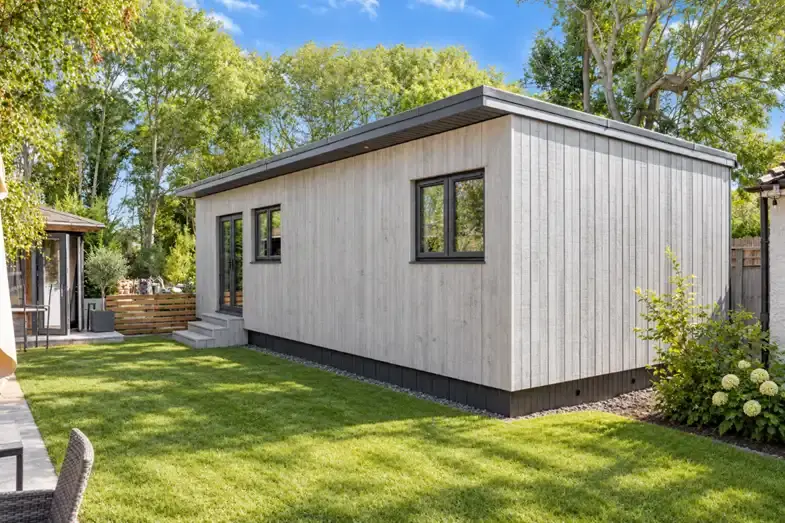
How a Granny Annexe Can Transform Childcare and Family Support
When people first start looking into a granny annexe, the conversation is often centred around the person who will be living in it. Perhaps Mum and Dad are looking to downsize, a parent is finding their current house too much to maintain, or the family simply wants to be closer together.
What sometimes gets overlooked is the effect that arrangement can have on the rest of the family, particularly where young children are involved.
For working parents, childcare can involve a fairly complicated weekly routine of nursery sessions, school runs, breakfast clubs, after-school care and grandparents stepping in wherever possible. Add school holidays, inset days and the occasional phone call to collect an unwell child, and even a well-organised routine can quickly unravel.
Having grandparents living in the garden isn't going to remove every one of those pressures, nor should moving closer to family come with an expectation of becoming a full-time babysitter. What it can do is make the everyday support that already happens in many families much easier.
Grandparents Already Provide a Huge Amount of Childcare
Plenty of families already rely on grandparents for at least some childcare. The difficulty is often geography.
If grandparents live an hour away, asking them to collect a child from school involves a two-hour round trip before the school run has even been factored in. Helping for an hour while somebody finishes work can simply be impractical.
Put the same family within a few metres of one another and those small bits of help suddenly become much easier.
It might be Grandma collecting the children from school on a Wednesday, somebody being around for an hour after nursery, or having help when a parent is unexpectedly held up at work. During the school holidays, it could simply mean the children spending the afternoon with their grandparents rather than needing another full day of organised childcare.
None of those things individually sounds particularly significant, but over the course of a working week they can make an enormous difference.
The Cost of Childcare Is Only Part of the Story
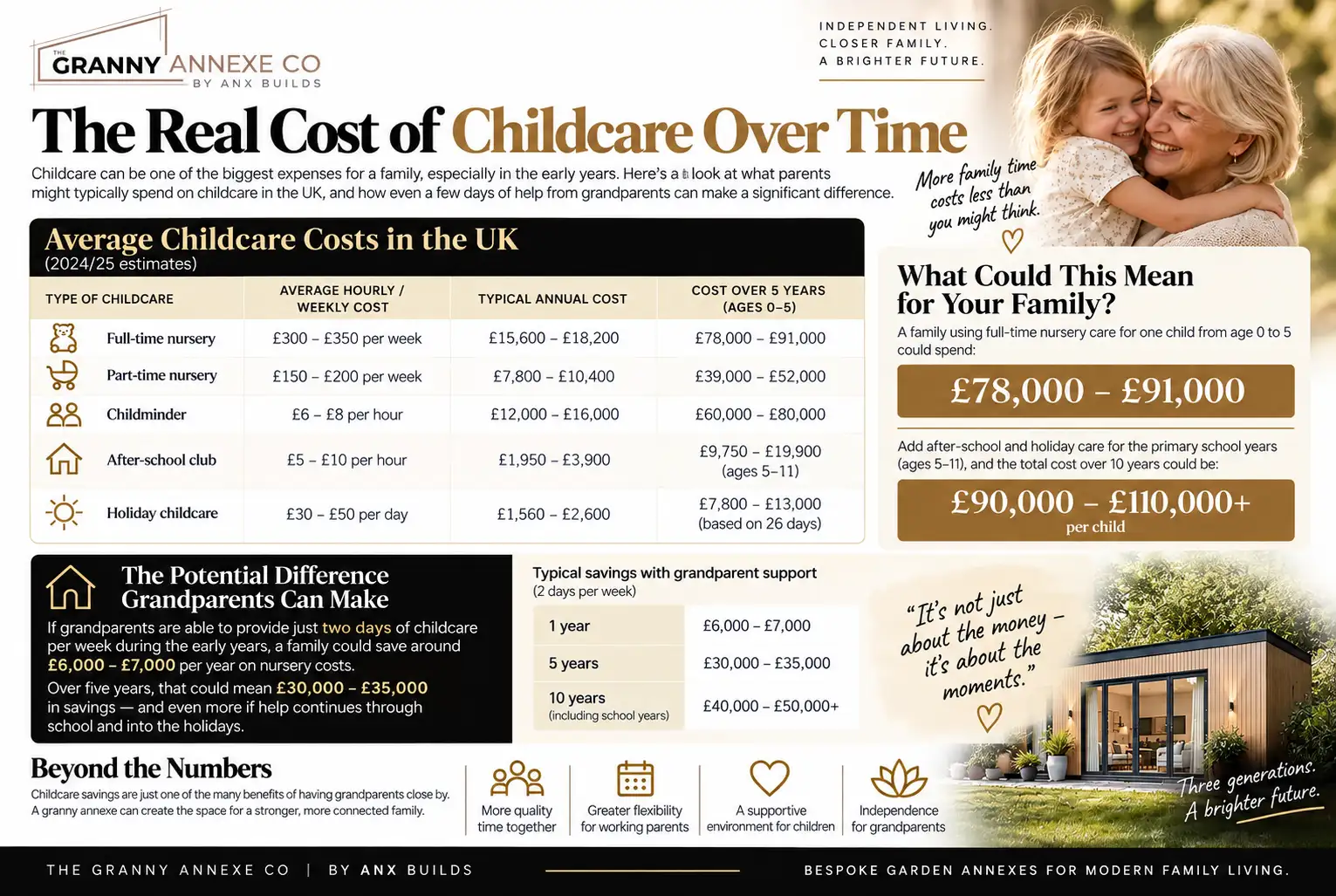
There is obviously a financial benefit where help from grandparents reduces the amount of paid childcare a family needs.
For households with young children, nursery and childcare costs can run into many thousands of pounds over the years. The costs don't necessarily disappear when children reach school age either. Breakfast clubs, after-school clubs and holiday childcare can continue for years afterwards.
A family doesn't need to replace paid childcare altogether to see a benefit. If having grandparents nearby means reducing nursery by a day each week or using fewer after-school and holiday sessions, the savings can accumulate over time.
But looking only at childcare savings misses the wider point.
Money spent on childcare pays for a service at that particular point in time. Building an annexe creates a home that can continue serving the family long after the children have stopped needing childcare.
That difference becomes particularly relevant when families start thinking ten or twenty years ahead rather than simply looking at their current monthly outgoings.
It Works Best When Everyone Still Has Their Own Space
One concern we regularly hear when families first consider multi-generational living is whether living so close together will actually work.
It's a reasonable question.
Most people wouldn't necessarily want to move back into their parents' house as an adult, and parents who have spent decades living independently don't usually want to feel as though they are moving into somebody else's spare room.
An annexe creates a very different arrangement.
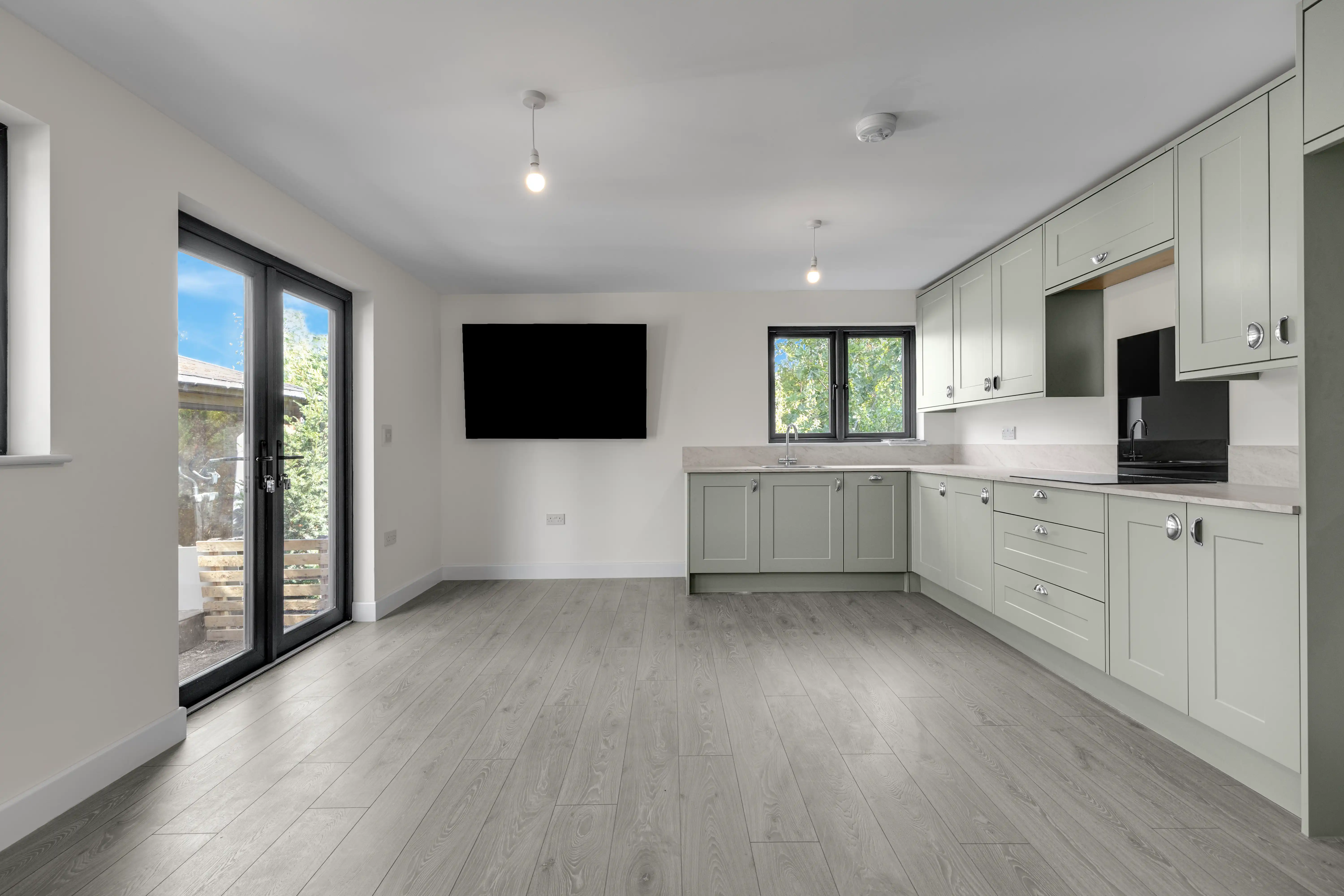
Grandparents can have their own kitchen, bathroom, bedroom and living area. They can have friends over, watch what they want on television and go about their normal routine without needing to organise their day around the main household.
Likewise, the family in the main house retains its own space.
That separation is important. The aim isn't to have three generations permanently living on top of one another. It is to give everyone their own home while making it extremely easy to spend time together.
In our experience, that distinction is one of the reasons families who may initially be unsure about multi-generational living start to see how it could work for them.
Family Support Doesn't Only Go One Way
There's another side to the arrangement that becomes more important over time.
When grandparents first move into an annexe, they may be fit, active and providing a great deal of support to their children and grandchildren. Ten or fifteen years later, circumstances can look quite different.
The grandchildren may no longer need collecting from school, while their grandparents might appreciate somebody being nearby to help with shopping, appointments or jobs around the home.
Eventually, simply knowing there is somebody a few seconds away can become valuable in itself.
This is one of the reasons we think it makes sense to consider future needs when designing an annexe, even when accessibility isn't currently a concern.
Single-storey living is already helpful, but features such as level access, sensible door widths, an accessible shower and a layout that isn't unnecessarily cramped can make a home much easier to live in later without making it feel clinical today.
The family dynamic can gradually change without anyone necessarily having to move again.
Children Get Something From the Arrangement Too
The practical benefits are easy to identify, but they aren't necessarily what families value most once everyone is living close together.
When grandparents live a significant distance away, seeing them tends to become an event. Somebody drives somewhere, arrangements are made in advance and visits fit around everyone's diary.
When they live in the garden, it can be much more ordinary than that – and that's arguably the point.
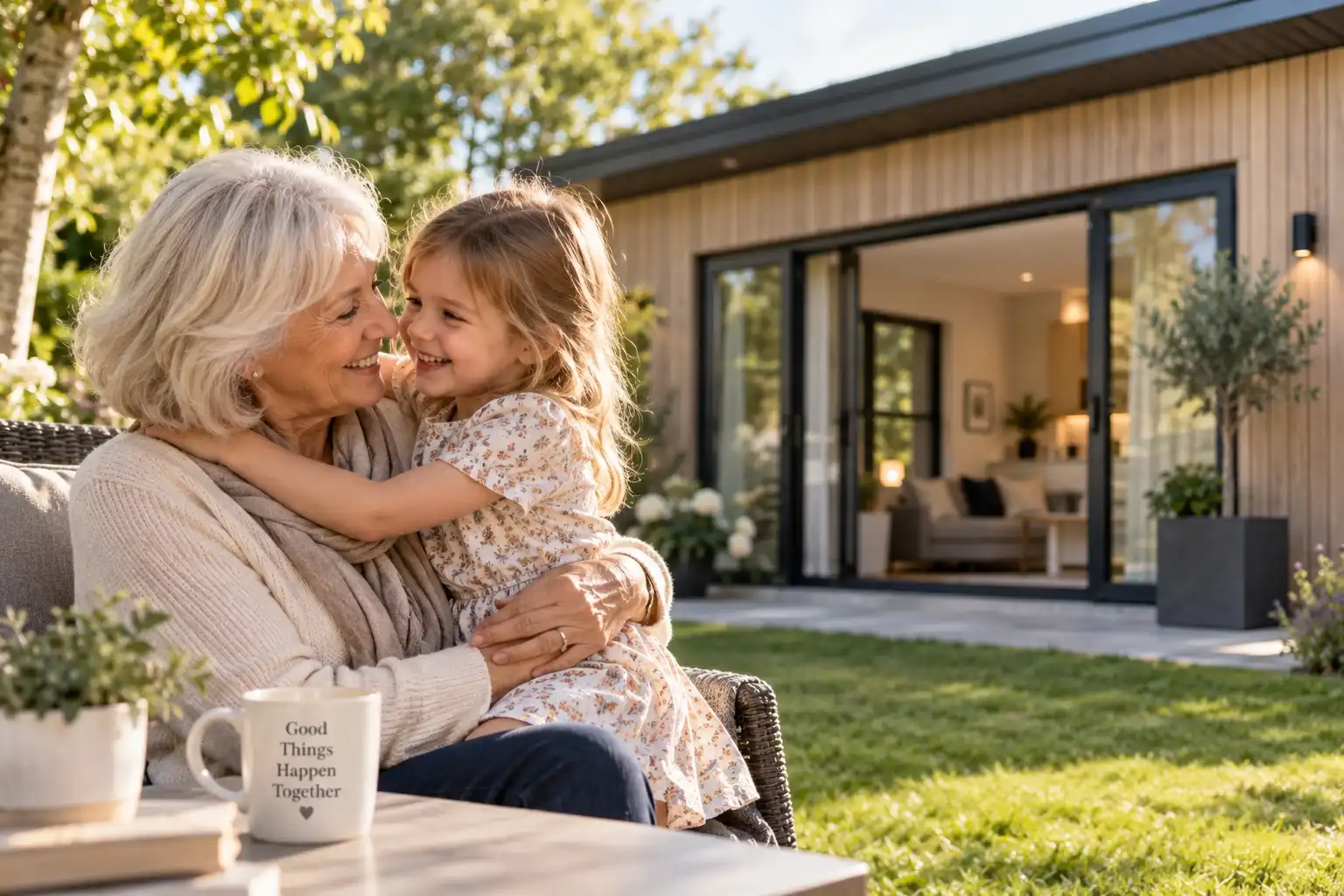
The children can wander over after school. Grandparents might join everyone for dinner and then go back to their own home afterwards. A grandchild can spend an hour with Grandad because they feel like it rather than because a visit has been arranged.
It gives grandparents the chance to be involved in the normal, uneventful parts of their grandchildren's lives.
Those aren't benefits that can easily be put into a financial calculation, but for many of the families we speak to they are a major part of the attraction.
It Can Take Pressure Off Working Parents
Working patterns have become more flexible for a lot of people, but working from home hasn't necessarily solved the childcare problem.
Anyone who has tried to take a work call with a three-year-old in the room will understand why.
There can also be a gap between when childcare or school finishes and when a working day ends. A grandparent being close enough to cover that hour can be more useful than it sounds.
The same applies when something unexpected happens. Trains are delayed, meetings overrun, children get sent home from school and childcare arrangements occasionally fall through.
Having family close by gives parents another option.
It doesn't have to become a formal childcare arrangement with grandparents responsible for the children every weekday. In many cases, simply having that extra flexibility is enough to take some of the pressure out of the week.
There Are Benefits for Grandparents as Well
For the arrangement to work properly, there needs to be a genuine benefit for everyone involved.
For grandparents, moving into an annexe can provide an opportunity to downsize without moving away from the people who matter most to them.
A large family home that was perfect twenty years ago can eventually become expensive and time-consuming to maintain. Moving to a smaller, modern home can mean less maintenance, lower day-to-day upkeep and a property designed around how they actually want to live now.
At the same time, they aren't isolated.
Their children and grandchildren are nearby, but they haven't given up the independence that comes with having their own home.
For some families, releasing equity from a larger property can also form part of the wider financial decision, although this is something that needs to be considered properly based on each family's individual circumstances.
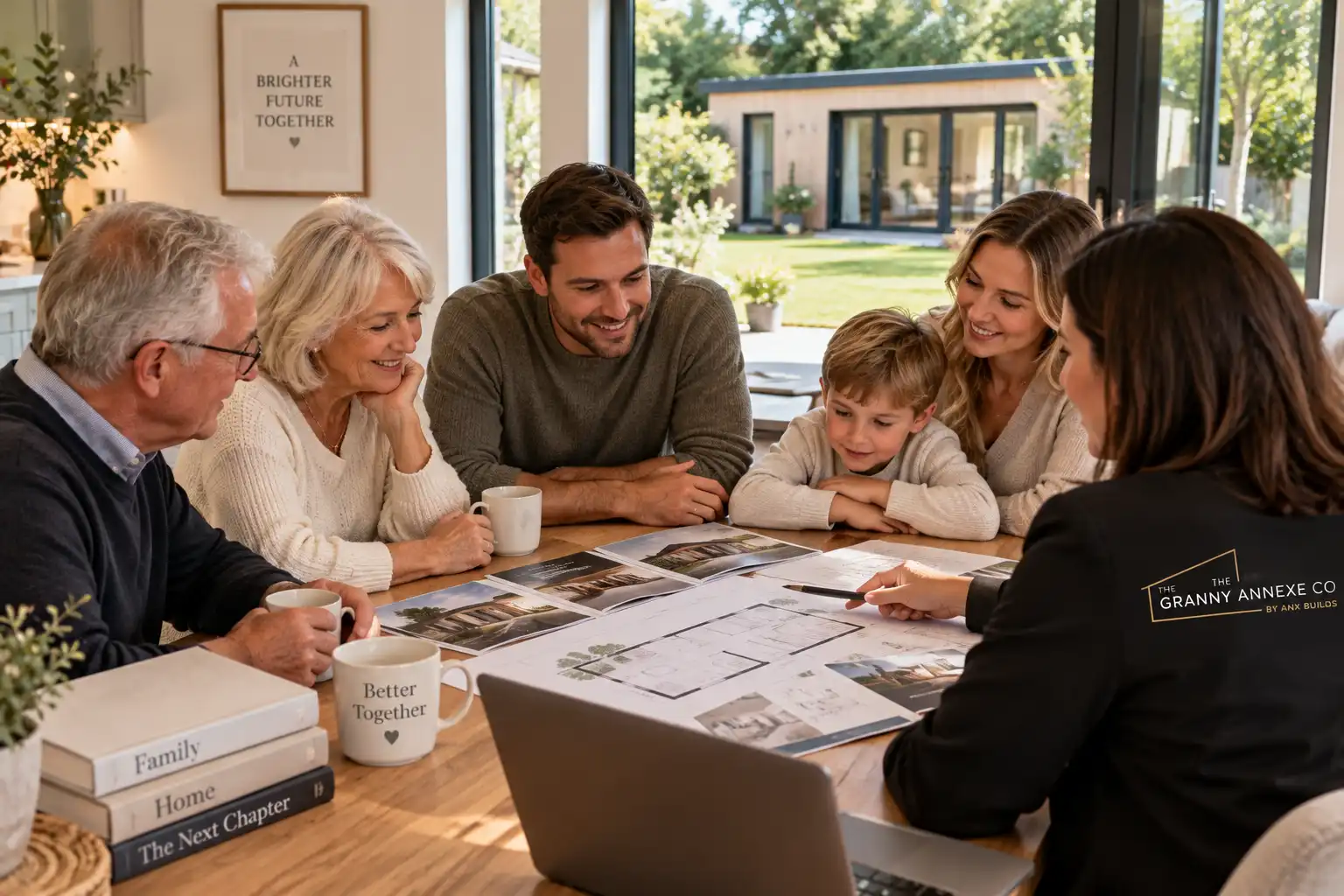
Think About the Arrangement Before Thinking About the Building
Before deciding what an annexe should look like, it is worth having a fairly open conversation as a family about how everyone expects the arrangement to work.
How much childcare are the grandparents actually happy to provide? Will the family eat together regularly or mainly live separately? How much privacy does everyone want? What happens if circumstances change in ten years?
There aren't right or wrong answers.
One family might have dinner together most evenings and share much of their daily life. Another might see each other a few times during the week and otherwise live quite independently.
The important thing is that the annexe is designed around the way that particular family wants to live rather than trying to fit everybody into a standard arrangement.
Where possible, it is also worth thinking beyond the immediate reason for building it. A layout that works for an active 60-year-old today should ideally still be comfortable if their mobility isn't quite as good at 75.
A Different Way of Looking at a Granny Annexe
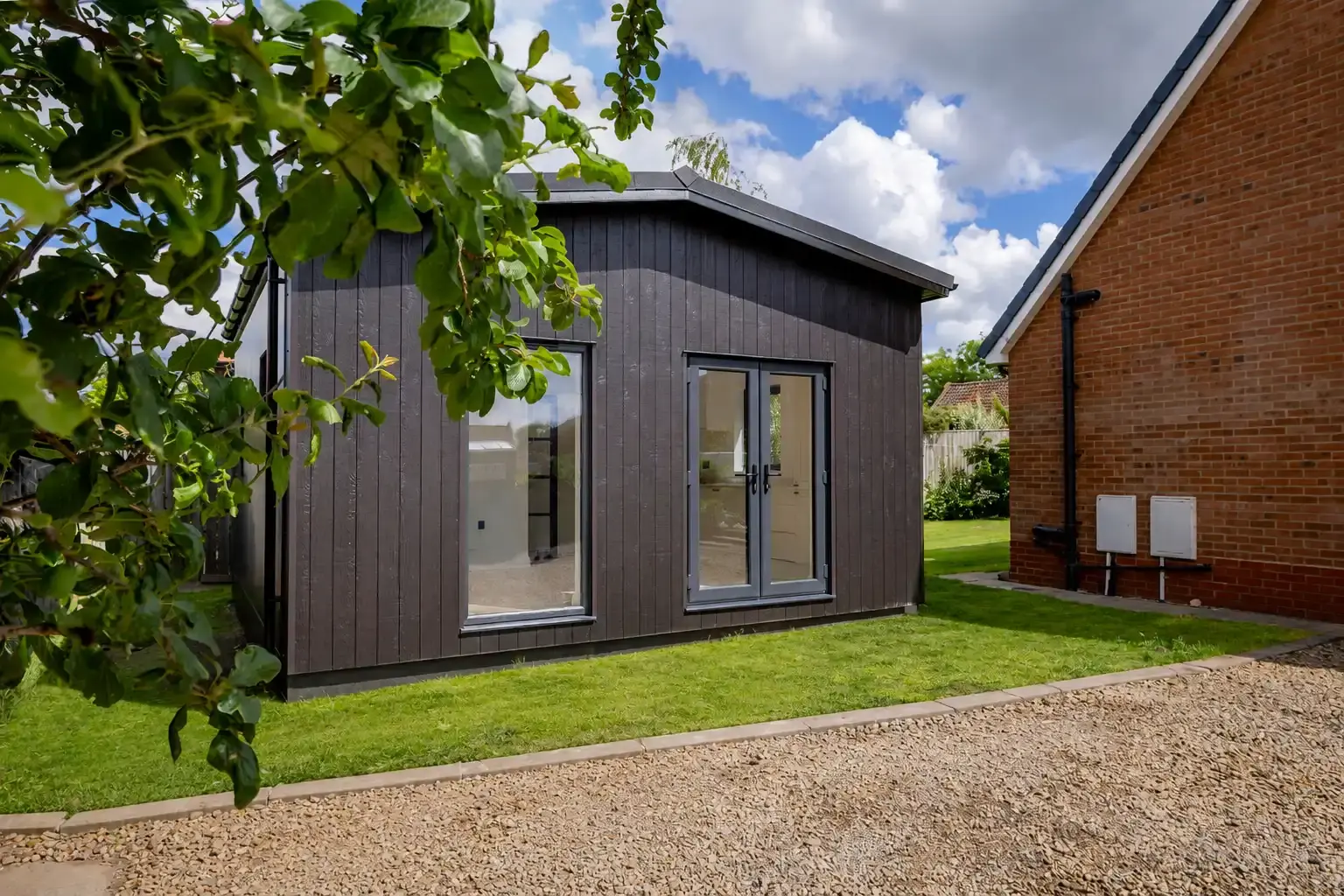
It is easy to think of a granny annexe simply as a smaller house in the garden.
For many families, though, the building itself is only part of the reason for doing it.
The bigger change is bringing two households close enough together that supporting one another becomes easy.
At one stage of life, that might mean grandparents helping with school collections, childcare and the occasional emergency. Later, it might mean their children being nearby when they need a little more support themselves.
In between, there are potentially years of grandchildren growing up with their grandparents as part of everyday family life.
Everyone still gets to close their own front door at the end of the day.
They just happen to be a few steps away from one another.
Designing an Annexe Around Your Family
At The Granny Annexe Company, we design each annexe around the family who will actually be living with it.
That means considering more than simply how many bedrooms are required. We look at the available garden space, how the annexe will relate to the main house, privacy, access, the way the occupant wants to live and how their requirements could change in the future.
Our team manages the process from the initial design and planning stages through to groundworks, service connections, construction and final handover.
If you're considering bringing parents or grandparents closer to home, you can speak to our team about your property, your family's requirements and what may be possible within the available space.
recent posts

Search
People also search for:
Top